
ساهموا معنا في نشر المعلومات الالكترونية باللغة العربية . نرحب بترجمة هذه المواضيع إلى اللغة العربية وسنقوم بنشرها في هذا الموقع مع أسم وعنوان المترجم والله لايضيع أجر المحسنين
Basics of Electronics, Part I
Want to understand electronics, build your own projects, and maybe invent new
things in the future? Well, in order to be able to do that, you will have
to understand some basics first.
What is Electricity ?
Electricity is made up of atom matter. To understand that you have to understand the basics of atomic structure.
Matter is commonly made up of mass which occupies space. This mass can
become and take into form several different states:
solid
liquid
gas
plasma
Matter has mass and weight. The atom also has motion and two kinds of energy types:
POTENTIAL ENERGY, which is a result of its position and KINETIC ENERGY, which is the energy of motion.
The structure of matter can be confusing, but I will try to do my best to describe it. Matter consists of very extremely small and tiny particles which together form an atom. There are 92 different naturally occurring atoms called elements. They are placed in a periodic table in sequence of their atomic number and weight.
There are also about 14 man made elements which do not occur in nature thereby making about 106 elements known to date. The elements value can not be changed by chemical means, only by atomic or nuclear reaction.
By value I mean the atom abject can not be changed by chemical means, but only by nuclear reaction.
How do you think they made the H and Atomic BOMBS ? They can also be combined to make countless number of things or compounds that we use every day. Kinda like mixing three colors; blue, red and green to make almost any number of countless colors or in this case, compounds.
The actual atom it's self looks much like our very own solar system. What I mean by this is, that it has a center like our sun, and planets rotating around it. The following example isn't 100% correct but it is very useful in visualizing the atom for the purpose here.
The center of the atom is called the nucleus (our sun), and it the center or the nucleus is primarily made up of particles called protons and neutrons. These two particles make up most of the atoms weight and mass. Orbiting around it are electrons (like our planets orbiting around the sun). The electrons are many times smaller in mass then their friends protons and neutrons. In a way this is true of our planets too :- ). There are other subatomic particles, but these aren't really all that important in understanding the basics and besides if you ever study quantum mechanics, they will teach you that.
All 106 elements posted in the periodic table are constructed out of these three major particles. The only exception is hydrogen atom, which has two of our friends, a single proton and a single electron orbiting around the center. Also for your information, the proton and the neutron have a mass that is greater by about 1845 approx. times that of an electron.
A Question that I got from a reader: Q. Didn't you say the hydrogen atom only had a proton and electron ? If so, why is the weight of the proton and neutron have a combined mass of 1845 times that of the electron, if there is no neutron present ?
I was simply implying that the weight on the proton and neutron have a combined mass of 1845 times that of a electron, that means that the electron is much more lighter then the proton and the neutron that makes up most of the atoms weight and mass.
As mentioned earlier, these elements are refered to by their atomic number and weight, and of course by their name too. Normally an atom has an equal amount of protons in the center as it has electrons around it. The number of electrons and protons is called the atomic number. The atomic weight is calculated by the total number of protons and neutrons in the center, rounded to the nearest integer.
An example of this is as follows: The element of Oxygen has 8 protons and 8 neutrons, so it is assigned an atomic number of 8 and an atomic weight of 16. In another example Copper has an atomic number of 29 and an atomic weight of 64. It has 29 electrons, 29 protons and 35 neutrons. 29+35 = 64 and the total number of electrons and protons is 29.
The electrons which orbit around the center of an atom are arranged by orbits, why! how about that, just like our planets :- ) In physics, these orbits are refered to as shells. Each orbit or shell represents a different energy level away from the center or nucleus and are only permitted at particular points in the atom and away from the center.
The total amount of electrons in the shell of an atom can not be more then a certain amount of electrons and the rules are spelled out as follows:
The first orbit closest from the sun, chuckle (from the center) can only contain 2 electrons, the second 8, third 8, fourth 18. The last outer most shell is called the valerance shell. The first four shells by definition have a name of, they are called: Helium, Neon, Argon and Krypton and they are named such because they represent the element formed when the shell is completely filled to maximum with electrons.
If you did not like my above cloun example, done to make learning easy, here is a more english correct version:
The first orbit closest to the nucleus can only contain 2 electrons, the second 8 electrons, the third 8 electrons, and the fourth 18 electrons. The outermost shell is called the valence shell. The name of each successive shell, when filled with electrons, is called: helium, neon, argon, and krypton.
Combinations of two or mote atoms of any kind are called molecules. Molecules constitute matter. Compounds that we earlier talked about are made up of molecules. If you for example take the compound salt (NaCl) which is a chemical combination of sodium (Na) and chlorine (Cl), and try to divide it an infinite number of times, you would still have salt. Because you would still have 1 atom sodium and one atom of chlorine. Once you chemically divide salt, it will no longer be salt. Interesting, isn't it ?
These major shells are further broken down into smaller shells within their orbit called subshells or orbitals. I will end here, if this interests you pick up a few books on the study of solid-state physics or chemistry and good luck :- )
I will try to make some pictures to better illustrate the above SALT example and write an example where the salt is chemically divided so that it won't be salt any more.
So, how is electricity made ?
Somehow I knew you were gona ask me this, hehe. Ok, the protons in the center and the electrons that orbit the center exert forces onto one another over and above the forces of gravitational attraction between them. It has been said that besides mass and weight, the electrons carry an electric charge that carry an electrical force. As far as who determined this, don't know exactly, but this is true.
There is a difference in electrical force between these masses and the gravitational force of attraction and repulsion exist. Protons and electrons attract one another to put it simply. Remember, like forces repel while unlike forces attract. This is why protons and electrons attract one another. Protons exert forces of repulsion on other protons and electrons exert forces of repulsion on other electrons.
From this, two types of electric charges were established, positive and negative. Protons in the center have been classified as having positive ( + ) charge and the electrons, you guessed it, a ( - ) negative charge. The neutron that is in the center together with the proton has a ? neutral charge :- ) and thus why it is called a neutron. Electricity is based on the law of attraction and repulsion. Just like life on planet earth is based on attraction between the opposite sexes. If that fails, we die :- ) If that isn't true in an atom, electricity dies.
Here is your first law to memorize:
|
Law of ELECTROSTATICS Unlike charges attract each other, like charges repel each other.
|
There are many ways that the normal balance within the atom can be altered, natural and not. The key to remember is that a charge remains until it is discharged. Then once it is discharged and it starts to move, it forms a current.
Charge Fundamentals
It is agreed that all electrons have precisely the same amount of negative charge in magnitude then positively charged protons. The directional quality of each charge is called polarity. Every object contains atoms and most of the time the amount of protons and electrons is the same and the net charge is neutral. But if on a dry summer day you rub your hair with a comb, then the net charge of the atoms in both your hair and the comb will change. As you rub the comb through your hair, you also rub off some of the electrons from your hair thereby making the comb more negatively charged with electrons and the hair more positively charged with protons. If you turn off the lights, you can even see small sparks of electricity jumping from the comb to the hair. This by the way is called static electricity. Why not from the hair to the comb ? Because of equilibrium, and in order so that the atoms of both objects can become neutral again, more will flow into less to create an even level. It's like opening a refrigerator on a hot summer day. If you keep it open long enough, sooner or later the temperature in the fridge will be the same as outside, taking into consideration that you turn off the generator that produces the cold.
There are many other examples, and I urge you to pick up a book and read it, otherwise don't expect to learn it.
A charged body, or atom is one that has an excess (that means more then it should) or deficiency (that means less then it normally should) of electrons orbiting around the protons and we know what they are, right ?
This difference can be written with a special number that states that difference. Most people think that when something is charged it has a positive charge, and this is not true. You should not confuse the word charge with a + or a -, because it can be either. Charged simply means that the atom is lacking some electrons thereby making more protons then electrons and this makes that atom more positively charged because there are more protons then electrons. Or if you have more electrons then protons, a such atom is said to be more negatively charged.
In real life, the scientists need a special number that states this difference. And because electrons are so small this number has to be larger then the individual electron or proton to make practical sense.
In honor of a famous scientists Charles Coulomb (1736-1806 Charles Augustin Coulomb), a large number or unit of measure of electric charge called the coulomb was adopted for everyday practical use. ONE COULOMB is equivalent to 6.24 billion billion of elementary charges and this can be either positive or negative.
Scientists have a special way of writing this and this special way is called the scientific notation. And here is how this notation of one coulomb looks like:
ONE COULOMB = 6.24 x 10 to the 18 power of electrons or protons. A lower case letter of q represents excess positive and the capital letter Q represents excess negative charge in a body. So one 1 coulomb that is positive can be simply represented by a q, and negative by a Q. ONE COULOMB IS 6,240,000,000,000,000,000 electrons or protons. Working with large numbers like this would be a real pain in the ass, so that is why special notations were invented to basically write the same thing but using much less space.
Charles Coulomb work in the investigation of forces showed that the force of
attraction or repulsion between two charges or bodies follows an inverse law
similar to Newton's law of gravitational forces between masses. Coulombs
law is as follows:
COULOMB'S LAW OF ELECTROSTATIC FORCES
The force (F) of attraction or repulsion exerted between two charged bodies is directly proportional to the product of their charges (Q) and inversely proportional to the square of the distance between them.
So, what the hell does that exactly mean ? :- ) Sometimes we have to read things one word at a time and look them up if you aren't sure to be able to understand something of complex nature.
It means, that the (FORCE \ strength or energy), of attraction or repulsion (EXERTED \ to put forth, to put something into action) between two charged bodies is directly (PROPORTIONAL \ corresponding in size, degree, or intensity, having the same or constant ratio) to the product of their charges (Q) and (INVERSELY \ opposite, reverse) proportional to the (SQUARE \ raised to the second power) of the distance between them.
The word Electron is Greek and it means amber, just so you know. What is an ion ? The outer most electron in an atom or in the valerance shell of an atom departs and the direct result of this is that the atom is no longer neutral. This is so because there are now more protons then electrons. This unbalanced atom is called an ion and it can be either positive ion or negative ion depending if an electron has been lost or gained. Imagine for a second this to make the following illustration easier. We all know how our solar system works in theory right ? The star is the sun, and then we have planets that orbit around the sun. Now imagine that all those planets are the electrons and that the sun is the proton, but instead of having just one sun there are many that occupy a space so close together that they all look like they are all one from far.
So now imagine that there are an equal amount of electrons and protons. If one planet or the electron looses it's orbit maybe because it was hit by a HUGE comet or asteroid, it might have received enough energy to enable it to leave it's magnetic orbit.
When it leaves the orbit and our solar system, it is leaving the atom. Over time it will go through space and join in with other atoms or solar systems where there is a lack of electrons to make them neutral or maybe join into an atom where there is already a neutral state and change it into a negative ion because now there is one more electron then the total number of protons and the atom is no longer neutral and this is where it becomes an ion (long sentence). This isn't how our solar system works, but it will help you to visualize the process. When there are more electrons in the atom, this atom ion is called a negative ion and when there is more protons it is called a positive ion, makes sense ?
Now the energy to make the electrons jump from atom to atom can be brought by many means: light, heat, magnetic energy, understand ? good. An ion is simply a charged atom, an atom that is not neutral. Different elements or materials in real life that are made up of atom give up or accept these loose atoms at varying levels. Now I will tell you about these elements as they are very important in electronics and this is where you will actually start to get familiar with some of the terms used in electronics.
Source of Electricity and Common acceptable units of measurement used in Electronics
Energy can not be destroyed or created, it can only be converted from one source to another. But I sometimes wonder if this is true :- ), where did the energy come from to create the universe ? The big bang, it had to come from somewhere, and that somewhere where did it come from ?
So maybe it is possible that something can be created out of nothing, magic ?
Anyway back to our subject. We always think of a SOURCE of energy as a battery, that would be a good example or the A/C electrical outlet. However, please remember that a SOURCE is not necessarily a reservoir or storage for and of energy. A more correct way is to call a source a means of converting some other form(s) of energy into electrical energy. An everyday battery that we use in our flashlight for example stores absolutely no electrical energy, believe it or not. What it does do is convert chemical energy into electrical energy when activated. An electrical generator simply converts mechanical energy into electrical energy. Through the phenomenon of ionization that I explained above, atoms cam become either positive or negative ions. Now here is the important thing to remember. When two separate bodies have a difference in charge, what they do have is described as "DIFFERENCE of POTENTIAL (PD)." Without this difference batteries would not work, and this is what happens when there is no longer any difference, and the battery goes dead.
" HEIGHT=21 WIDTH=32> the electric current flow ? from + to - or from - to + ?
Rechargeable batteries when they go dead are simply recharged to introduce this difference once again, and with time it will go to neutral and it will die. An electrical circuit connected between these two bodies or simply the battery will permit a movement of energy from one body to the next. And this transfer will continue as long as there is a difference in potential. Think of it this way if it makes it any easier.
Find two big jars, clear would be the best. Fill the first one 1/2 the way and the second one all the way with water. Now place a clear plastic tube between these two jars and suck some water from the bigger jar into the smaller. The water will flow until both jars become neutral. Since the one that has more water will come closer to having the same amount of water as it's brother, there will be less and less of a potential difference and the water will flow through the tube slower and slower until PD no longer exist and there isn't enough water in jar A to keep the water pressure in the tube transferring to jar B.
Makes sense ? This is how batteries work. As the battery becomes weaker and weaker the reason for this is that it simply is losing it's PD and electricity can no longer flow and the direct result of that is that the battery goes dead.
The unit of measurement of this potential difference that I just explained to you is called VOLT. Finally you understand what it means, isn't it cool ?
Also, Voltage can be represented with V, E or EMF. V is obvious = VOLTS, E also stands for Volts, you will learn about that below and EMF which stands for (electron moving force).
The letter V is used as the symbol for voltage in transistor circuits.
Now to understand the full meaning of VOLT can be a little bit tricky, and that is why it is VERY important that you read everything, boring or not, because there is a reason why it is documented.
The scientific notation for the value of VOLT can be confusing to someone who is new, if you havn't read about COULOMB and what it is, now would be a good time to go back and do so, or you will be lost and this section is VERY important.
Since we know that VOLT is used to represent the PD (see above) this is what it means. When the PD movement occurs, WORK IS DONE, be it in an electrical circuit or a home circuit. This work is expressed as "WORK PER UNIT OF CHARGE" or "JOULES PER COULOMB". A JOULE is approx. .738 foot pounds of work and the COULOMB is (see above).
The VOLT is equal to the PD required to move 1 COULOMB of charge and accomplish one JOULE of work. This is expressed by this following equation:
V = W/Q
V stands for VOLT, W stands for work in joules and Q stands for Coulombs.
A fixed value of 1 VOLT has been established by the International Electrical Congress and by law in the United States.
The movement of electrical energy or electricity through a electrical circuit is called CURRENT. The current is what does the work in the circuit. VOLTAGE does not do any work, it does only cause the current to flow. Current is also what kills you if you don't use common sense.
Now is where this gets more interesting, but remember, DO NOT skip any sections of my writings, or you will get lost and that isn't good. An AMPERE of current is described as the current flow in a conductor at the rate of one Q (COULOMB) per second at any given point in the circuit.
Current my fellow friends is assigned the letter "I" and current is measured in AMPERES, MILLIAMPERES and MICROAMPERES. Current is simply electron flow and for the sake of complexity I will always refer to it as moving from minus to plus or negative to positive but I will also describe the difference later.
POWER
Energy is the ability to do work and Power is the rate of doing work. Work in Physics is the product of force and distance and work is measured in foot-pounds. For example: If you lift 1 pound over one foot from the ground, you accomplish one foot-pound of work. When you ad the element of time into this same lift scenario then you just lifted the weight once each second and your rate of doing work would or POWER would be "one foot-pound per one second". This is of course only an example, it might take you 60 second to lift that for all I know, then the answer would be "one foot-pound per 60 seconds". If you lift more then one pound then that changes to: "five foot-pounds per 60 seconds."
Therefore, power is work divided by time or:
P = W/t
P = Power, W = Work in foot-pounds, t = time
In electronics, we know by now that VOLTAGE is the force and that AMPS is the movement of electricity per second or current. To better illustrate this point think of it this way. Imagine a water pipe, this water pipe can be compared to an electrical piece of wire to make my point. Still (not moving) Electricity is water and the moving electricity is current or AMPS.
So, if we have water in the pipe, then we can call this as having VOLTAGE inside of the wire. Now, if the water is just sitting there in the pipe and it is not doing anything, or it is not flowing through the pipe, then there is no current of water, right ?
Well, the same thing can be illustrated with the wire, if all we have is the electric VOLTAGE, all that it shows us that we have electricity in the wire and how much of it and the force that it is capable of producing. Once we open the pipe, water flows and we have just that, running water that can be used to do something with. Same thing with electricity in the wire, once we let the circuit run, we have AMPS or current.
Later I will show you what WATTS and OHMS are.
One AMPERE = 1 COULOMB per second moving through the wire. Equation: P = I x E
Power is measured in WATTS. Watt is named after James Watt, the inventor of the steam engine. To convert mechanical power to electrical power this is the equation that we use.
1 HP = 746 watts. HP stands for HORSEPOWER, and in mechanics this is used to measure the rate of work.
This same above Equation can be written in three different ways. P = I x E, E = P/I or I = P/E.
/ is the division sign and x the multiply or times sign for math purposes.
When you know any of two values of current, voltage or power, then it is possible to find the third unknown value using any of the three equations above.
To give you an example here we go: An imaginary device operates on 220 VOLTS and draws 10 AMPERES of current. What is it's power ? This question is very simple to answer. P = I x E, we know I = 10 amps and E = 220 volts, so the answer is ? 10 times x 220 = 2,200 watts. Mind that this is only an example.
CONDUCTORS, SEMICONDUCTORS and INSULATORS
One of three most important materials in electronics and electricity are just that; conductors, semiconductors and insulators. We have probably heard of some of these and to some degree understand what they are. So therefore I am not going to waist a lot of space and will cover enough so that whatever you might think you know is corrected or refreshed and added to what you already know.
Voltage is the source of Energy at rest, it is very important again that you understand this. Voltage is part of what makes the circuit work, but voltage is only the PD at rest and not at work. For example a battery, the 9V one that everybody is familiar with must be connected to something in order for it to work, when it is connected and the switch is on, the cell :- ), is ready to do useful work.
Here is another very easy example of VOLTAGE. Imagine a glass jar, fill it with water. There, you have voltage, a storage of potential energy, when you hook up a pipe to this glass jar and let the water run, you create current through the pipe and you have amps, the more water is moving per sec through the pipe, the higher the amps. When the water is no more in the jar, none left, you have no VOLTAGE left. The more water, the more voltage you can fit, or potential energy. Hope that you understand this, because I don't know how to explain it any easier then this.
But I will try again :- )
Ok, when you go to a store and buy a BRAND NEW! 9VOLT cell or battery as everyone knows it by, what do you have ? a new 9Volt Battery capable of delivering 9VOLTS, right or what ? sure.
Ok, with time this brand new 9Volt battery will lose some of it's voltage and even though it is marked on the outside as a 9V battery, inside it is no longer delivering 9VOLTS, but maybe 6 volts or 4 volts.
This is why flash lights go dimmer and dimmer, because the voltage gets lower and lower.
You can compare that to our jar of water example above. Get a jar, fill it with water, all the way up to the top, and take a marker and label it as a 9VOLT battery or a 9 gallon jar.
Now hook up a pipe to it, let the water run through the pipe, you now just created AMPS, the water in the jar is still VOLTAGE, but once it enters the pipe it is called AMPS. The energy or water is coming out of a 9VOLT battery, so we call it just that.
So to give you a better understanding of AMPS vs. VOLTS, it is simple. Volts is the energy and AMPS is the measurement that we use to see how fast and how much of that energy is moving through the pipe, I mean wire.
You can have a 1,000 VOLT storage battery that is capable of delivering 1,000 VOLTS, but you can increase or decrease the AMPS by turning the faucet ON more or OFF more.
But please also remember that AMPS are propotional to VOLTAGE. If VOLTAGE is increased, AMPS are too.
You will learn more about this later.
Just like in the bathroom or a portable water storage tank. You only have so much water in it, the more water you let through, the faster it will move, or more AMPS, when you reduce the water flow, less AMPS, but the VOLTAGE source stays the same for a time anyway.
As you increase the AMPS you will draw more VOLTS from the battery or use it up much faster. That's like letting more water through the pipe, you use up more of it from the jar. Now I think that this is the best example yet.
This is how it works with D/C Electronics (batteries). A/C is much more complicated and you have to know much more to be able to understand it fully and be able to compare them both. With A/C the voltage is contstant, because it is coming from a source that is not a battery but a freaking energy plant. As you increase the AMPS, there is always enough water to keep it up, because it is not coming from a limited source, but from the electric company who is replacing the used up energy as fast as you use it up. This is only a theoretical example, keep that in mind.
This of course works differently with A/C electricity then with D/C. Will explain the difference later.
If you still have a problem with VOLTS and AMPS, then electronics are not for you. It's time to find a new hobby.
Just so you understand resistance better I will tell you ahead of time with this example of how this works and then you can read about it below later. As the water is flowing through the pipe, the pipe opposes the water, like friction. The less space is left in the pipe to make the moving water fit, the higher the pressure builds.
This can be compared to resistance. You'll see below anyways.
The current must past through wires so that the electricity can reach it's components, kinda like valves in water pipes and pressure generators and such. Now we will investigate the properties of certain materials with respect to their ability to conduct this electricity.
The true ability of how and why electricity is capable of moving or flowing through conductors can be reflected back to the top of my writings, it has to do with the atomic theory. I only covered the basics and this Internet Paper wasn't designed to replace books and libraries. So if you really want to understand this 100% or close to it, please pick up a book on the atomic theory. Your teacher should be able to recommend some good books for beginners or simply stop over at your local library like I did and start reading. :- )
conductors: basically, some materials conduct electric current very easily with little energy applied and resistance, these types of materials are called conductors. insulators: other materials require a very large or much larger amount of energy to conduct an electric current only very slightly. These are called insulators. A typical electrical wire is made out of two type of materials. A type of metal that resides on the inside "this is the conductor" and some type of insulator on the outside of the wire, coated. Insulators serve several purposes. One very important one is that they will protect you from being able to touch the wire and save your life from an electrical shock and the other is so that different wires don't touch each other to prevent an electrical short circuit which can lead to a meltdown, fire, explosion and loose of life. Insulators are also used to cover sensitive electronics to shield them from static electricity and from damage.
Good conductors are: Gold, copper, silver, etc. Good insulators are: plastic, rubber, glass, bakelite, air, asbestos, etc. Now the in-between type of materials that are in-between the conductors and insulators are called the semi-conductors. Good semi-conductors are carbon, silicon and germanium, etc. Semi-conductors are very important and they are used all the time to make all kinds of electronic devices. From resistors to transistors to solid-state integrated circuits that your computer get's it's life from. These will be explained later.
There is another one, but this shouldn't really concern you right now. It is called Superconductivity. Superconductivity is the phenomenon where the electrons move through the material at no opposition at all, no friction, no resistance, no opposition. But it is hard to make it work under normal everyday human like environments. -452 F. So there is still a lot of research that has to be done there and you shouldn't concern your self with it.
A little bit more information.
As a general rule, conductors are materials whose atomic structure is such that the valerance shell contains less then half of the total allowable number of electrons and the insulators more then half.
In some materials, electrons that circle the nucleus "wake up!", are held very securely and very close to the nucleus. These types of materials require large amounts of energy to break loose the electrons for conduction to take place.
These are INSULATORS. Good CONDUCTORS require no energy at all to free the electrons from the material. A material which is a good conductor already has many free electrons to transfer energy by conduction.
An INTRINSIC CONDUCTOR is made out of atoms of all the same type or kind. It is 100% pure you might say. Pure Germanium or SILICON are examples of this type of CONDUCTOR. These materials are classified as semiconductors.
Semiconductors conduct electricity to some extent, less then the conductors might at 100%. How much depends on the type of material or it's mixture and size. For example we use semiconductor materials to manufacturer resistors. Those can be compared to valves in water pipes where you slow down the water and only let some through to the other side of the pipe, kinda like a dam. If you have 10 Volts of electricity and you wanted to reduce it to 5, you would place a special type of resistor into the circuit to slow it down and maybe a heatsink or two to dissipate the heat from the resistor so it can last longer.
We add impurities to semiconductors to make them conduct better if that's what we want to do and most semiconductors used in electronic parts are made from a semiconductor material mixed with impurities. Impurities are selected which have FIVE valerance electrons. These include: Phosphorus (P), arsenic (As), bismuth (Bi), and antimony (Sb). These are classified as PENTAVALENTS.
The process of adding these pollutants :-), I mean impurities is called "doping" and the impuratants are called "dopants". Only a small amount of dopants is used when doping, approx. figure is about 1 atom of dopant to 10 million atoms of 100% semiconductor. Once doped, the material is called EXTRINSIC and it's conduction characteristics will change.
I will dedicate about 4 more weeks to this Basic project and that is it. If you want to know more, then it's time to read and research on your own as it is impractical for me to write about something that can easily be found in a library, but I do this to introduce you to it in an easier manner then most books do.
RESISTANCE
The Greek symbol of " p " -(rho) is the symbol of SPECIFIC
RESISTANCE. Different MATERIALS some of which are metals resist in
different ways. There is a table that shows this SPECIFIC RESISTANCE for
the most common used materials in electronics:
|
MATERIAL
ALUMINUM CARBON CANSTANTAN COPPER GOLD IRON NICHROME SILVER STEEL TUNGSTEN |
p (rho)
17. 2500-7500 x copper 295. 10.4 14. 58. 676. 9.8 100. 33.8 |
Silver offers the least resistance, but it is expensive. Aluminum offers almost twice as much resistance as silver does. This is how I read these charts. 0 would have no resistance, and there is no material on this planet operating in normal conditions that can have a 0 unless we are talking about it operating under superconductivity, but that's another story.
Now to explain resistance. Certain materials vary in their ability to conduct electricity. Basically the material is resisting the flow of electricity. Resistance can be compared to friction. You know what friction is ? almost the same thing.
Resistance is like opposition. Some materials oppose the electric current more then others, but all oppose it to some degree.
Now here is another COOL new fact that you will learn today. You might have seen this when placing your BOOM BOOM speakers into your fast car. Well, it's time to understand what the hell those marks mean.
Resistance has been assigned the letter of R and resistance is measured in
OHMS in memory of George Simon Ohm (1789-1854). The Greek symbol for OHM
is the omega symbol.
One ohm of resistance will permit a current of one ampere to flow at an applied potential of one volt.
Materials with greater resistance require greater energy to raise electrons to the conduction state. Energy is consumed by resistance and it results back into the form of HEAT. That's why many electrical appliances and computers use heatsinks to move the heat away from the components to reduce wear and to ensure a longer operational life.
Many times resistance is introduced on purpose and it has a specific use in our daily life. Like ? Like electric ranges or heaters that we use at home. The heaters that we use to heat water with. Your coffee maker or that little electric heater you use to heat your aquarium water with. Ahhhh! :- )
Resistance is also represented by a circuit drawing, called a schematic
symbol for resistance: 
Resistance uses an infinite number of uses in electronics and it is impossible for me to mention them all. As for your car speakers, that number shows the maximum resistance that the speaker is capable of withstanding before blowing up.
Just like a water pipe can only withstand so much water pressure before bursting, same thing. Follow the OHM rules and your speakers will do just fine. But we have a little longer to go before you will be able to understand this all clearer and I will do my best in describing it to you in as plain of an English language that I can.
Resistance in a conductor is influenced by four major factors and those are:
Material of conductor
Size of conductor
Length of Conductor
Temperature of Conductor
More...
R = the resistance in ohms, I = the length in feet of the material being used, A = the cross-sectional area in circular mils and we will cover that later don't you worry about that, p = the resistivity which depends on the material structure and it's temperature and also size.
The formula for OHM is: R = pI divided by or R = pI/A
Before I can demonstrate this law to you and how to properly use it, it is time to introduce to you Gauge used to determine wire size and what circular mils is.
When you think about it and use some common sense, wire works like pipes. You can expect that a larger wire or pipe will conduct electricity or water more freely and in greater quantities than a small wire or pipe. Am I right or what ?
Sure I am. So. It is said in electronics that the resistance of a wire is inversely proportional to its size. This means simply that if the wire is larger, the less resistance it will give off. The smaller the wire, the greater the resistance.
My friend, he doesn't know much about electronics, just some simple basics and even those aren't very clear. What he did was very dumb, please don't laugh, but I have to tell you this. He has a car, daaa :- ) and his radiator fan stopped working. So he checked the fan, it works, he checked the thermo switch, that was good and he checked the fuses, they were good, but the fan refused to turn ON when the engine got hot. I really didn't know what the problem was, maybe a short circuit somewhere or maybe the computer was busted. But he decided to cut the wire off that led to the thermo-switch and create a manual switch override to turn on the fan. He went to radio shack, bought the wrong wire and the wrong switch and then connected them to the car's battery and then to the radiator fan. The plan seemed simple, whenever he noticed the temperature gauge inside the car get up there to indicate that the engine was getting hot, he switched the switch ON.
What happened ? At first nothing, it worked. But the wire got hot quickly very fast and so did the switch. Now why do you suppose that happened ?
This wire he got wasn't designed to carry this much APMS and wasn't able to handle the current. Sure it carried the current, but because it was too small the wire began to get very hot. If he didn't turn it off quickly enough, there was a good chance that the wire would burst, like a water pipe when trying to pipe too much water at high pressure through a small pipe resulting in a possible fire, explosion and he could maybe even have died.
Really stupid! Don't do that boys and girls.
Electricity can be your best friend or your worse enemy. So even if you
are not planning to become a rocket scientist, it is a good idea to know these
basics.
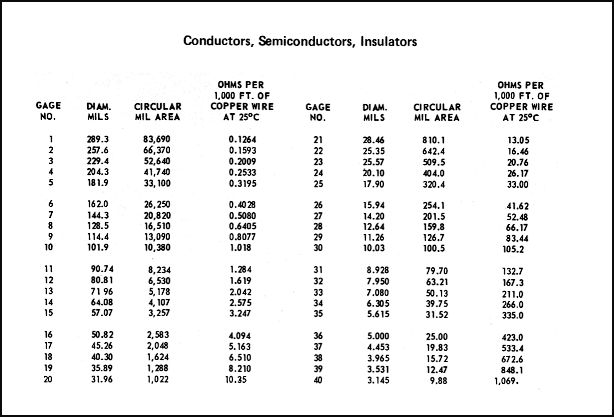
The size of a wire is specified by a special number in the land of electronics. This is called the Gauge number. The larger the number, the smaller the diameter of the wire, this is how this works. The number 20 and 22 are commonly used for hookup wire in electronics equipment. Numbers 12 and 14 will be found in light circuits in your home. Number 6 wire is used to connect an electric range. The size of the wire is determined by the amount of current the wire is required to carry.
If the wire is too small, it will heat-up, like in our little example above. The heat up is due to loss of energy as it overcomes the resistance of the wire. You should never apply more energy then what the wire is rated for.
The inch system in English is not used to measure wire size. Wire my friends is sized by CIRCULAR-MILS, which is its cross-sectional area. One circular-mill is the area of a circle one mil or .001 inch in diameter.
Incase you forgot your basic geometry laws here they are again to refresh your memory.
DIAMETER: the length of a straight line through the center of an object. RADIUS is: a line segment extending from the center of a circle or sphere to the circumference or bounding surface of the circle.
A wire that has a diameter of 1.00 inch would have a radius of .50 inch, right ? Please don't tell me that you are stuck on that one, if you are, please go back to elementary school and then come back here when you pass the grade.
By definition, a circular-mil is the area of a wire having a diameter of .001 inch or one mil same thing. This wire then would contain .7854 square mils.
.7854 x (1)2 = .7854 square mills, the 2 after the (1) is a power of two, 1 x 1 = 1
two square mills of .002 would be (2)2 or 4 x .7854 = 1.57 square mills.
It's easier to work with mills then with inches, because 1 mills is .001 inch, 10 mills is .010 inch, get it ? if you were working with inches then you have to use a complicated formula:
A = pie R2 = pie (D/2)2 = 3.1416 x D2/4 = 7854 D2
2 = the sign for power of two
The best way to think about it for me atleast is to convert inch to mills and that is easy to do, because .001 = 1 mill, and then use the above first shorter formula to compute the square mills.
The most common way of designing a wire's resistance for everyday electronics or for electric use is to use ohms per circular-mil foot. A circular-mil foot is a wire having one circular-mil cross sectional area and is one foot long. Basically a one foot long piece of wire is one having one mil or .001 inch diameter.
For example a piece of wire that is 3.145 mils in diameter is not a piece of wire 3.145 inches long, it is a piece of wire 0.003124 inch in diameter or basically 3/100th of a inch in size. That's pretty small and it's by the way Gage No. 40.
For example Gage No. 1 and remember that the smaller the number the larger the wire, is 289.3 diam. mils or 0.2893 inches in diameter which is a pretty big piece of wire.
If you think that 1/100th of an inch is small, then you should buy your self a pair of calipers. They are capable of measuring 5/1000th of a inch in diameter. If I remember regular paper used for a copy machine is 0.0035 inches thick.
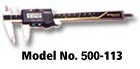
And to end this talk about Mils and remember that 1000 mils is 1.00 inch, and that should help you.
.999 mils is like .999 inches.
It's like this:
.001 inch is 1 mil, .005 inch is 5 mils. Then to find the circular-mil area of this wire you would use this formula.
.7854 x (5 mils)2 = 19.64 square mils
to find the circular-mil area of this wire, divide it's square mil area by .7854, and that would be 25.01 or 25.
Ok, so what is the diameter of a wire in inches that is 50.82 diam in mils ?
0.05082 inches or 2,582.67 or rounded to 2,583 circular mil area. How did I get that ? I used a power of 2 on the 50.82 and then rounded off the answer.
AGAIN! 1 circular-mil is the area of a circle one mil or .001 inch in diameter. And you know what that is, right ?
If you want to see the Wire gage Table, get a book on electronics or visit Radio Shack, they should have one. There are also Gauge wire instruments that you can use to quickly determine the Gauge No. of a wire. Radio Shack should sell it, or any other good electronic shop.
There are all kinds of wires; bare, insulated, twisted, used for different purposes. There are also wires that are stranded from many other wires to make one wire. This is done to provide the needed cross sectional area to carry more electric current. It also provide flexibility for better handling. Twisted wires don't automatically mean that they will be BIG wires, they can be small wires too. If you use wire that is made out of one strand, and if you need for this wire to be very flexible when bending without damaging it's self, then a stranded wire is the best one to get, otherwise over time the wire might break/snap in half if you use a single strand.
Also, the wire's resistance will increase as it's length is increased. For example, if you just finished calculating that your wire's resistance is 2 ohms per a foot, then this will increase to 20 ohms for 10 feet. 2 x 10 = 20 ohms. Incase you are confused about this, it means that the wire will oppose the electric current more as it's length increases and will oppose it less as it's length decreases, get it ? The same thing works in reverse. If the wire is shortened, it's resistance drops.
Hmm what else ? Ohh ya. Most of the time, the resistance of the wire will increase as the wire get's hotter. Before I go on and just incase you are still confused about what this resistance means it is simple. Resistance is opposition. More resistance means more opposition, less means less, think of it that way.
Why doesn't the wire conduct better at higher temperatures ?
This has to do at the atomic level. To put it simply, at higher temperatures, there is many more free electrons and there are also many more collisions inside of the wire as the electrons jump from one atom to another. This disrupts the electric flow and lowers the conduction ratio of the wire. Cool or what ?
I say that this happens most of the time but not all the time. There is nothing ALWAYS in this world. Semiconductors will conduct better at higher temperatures. If you want to know why, that will be your research project. Start reading and visit your local library, I am not going to tell you.
Ok, that's enough about wire. Now I will start to cover the actual electronics components. I bet you waited for this moment ? Ok. The first one that you will get familiar with today is called a resistor. The job of a resistor is to do just that, resist electricity. There are many many many uses for resistors and they are used in almost everything from computers to televisions to radios, etc.
The following is a picture of a typical carbon resistor: 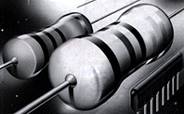
Here is a better one, made by me :- )
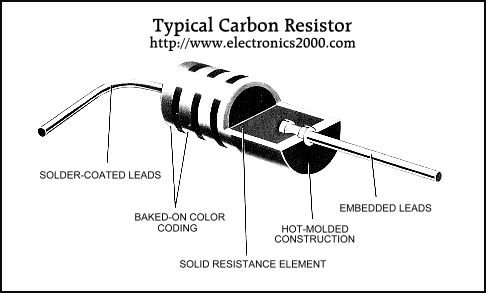
Resistors are made from all type of different materials, from carbon to special film, etc. and there are as many different types of resistors and sizes and what they are designed to be used for.
I am not going to cover all of them, because if you made it this far, you must be a person who likes this stuff, so it is very safe to say that you will do a lot of investigating and learning on your very own. Hooray!
I will list a brief description of the most common resistors that are used in hobby electronics and how they work and a little bit more. Then I will finish this basics of electronics section and move on to mechanics and gears.
The resistor is labeled with a special sign in a schematic drawing that looks
like this:
CARBON RESISTORS are the most common type, (see picture above). Their resistance value is manufactured in a wide range of values from small fractions of an ohm to millions of ohms. Usually the larger the resistor the more heat it will be able to dissipate and therefore it will carry higher currents without melting down. Electronic components are rated for resistance just like our little friend the wire is. Make sure you use the right type of components or you will fry them if you use the wrong ones or even worse start a fire. Therefore, larger resistors, can resist larger amounts of current or AMPS, because that is what current in electricity is measured with.
POWER RESISTORS are used in high power circuits because they can carry a considerable amount of current, much more then the CARBON resistors can. These types of resistors are made out of ceramic material and usually wound with resistive wire around it. These types of resistors are made either with an adjustable slider to change the resistors value or a fixed value. Resistors that can have their value changed by our human hand by either moving a knob or a slider are called VARIABLE RESISTORS. The fixed type of power resistors are also called TAPPED Resistors, because the slider is tapped in a sense and you can't move it, it's fixed for good. I don't think that they actually make tapped sliders, but that is how that got its' name from.
To find out the schematic drawing for variable and tapped resistors, visit your local library.
One of the more popular variable resistors is called a POTENTIOMETER, which is a kind of a knob resistor that you can turn left and right, it looks like a switch but it is not. The carbon resistors have little color bands painted around them. They are there for a reason and not to look pretty.
This is called a color code. As I said earlier, electronic components are rated for resistance just as wire is. Everything resists electricity to some point. Instead of writing the number on the resistor, they paint them with the bands and you have to know the Standard Color code of the resistors to find it out.